Civil War
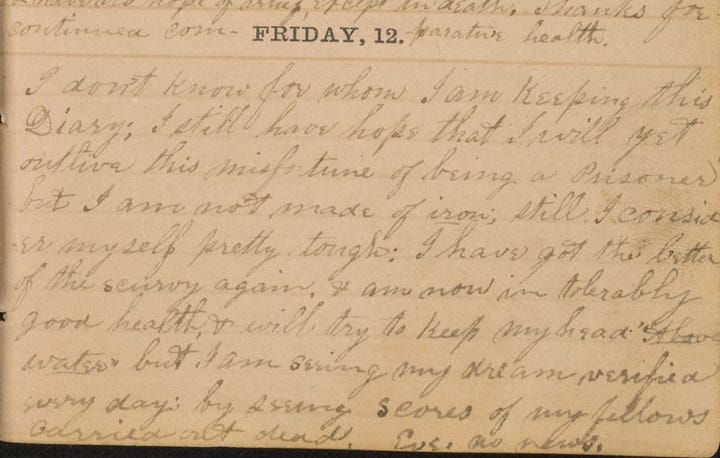
Samuel J. Gibson, Georgia (1864)
Edited by Liam Michael Crowley (2021)
Although its duration was merely four years (April 12, 1861 – May 9, 1865), the effects of the American Civil War on those involved lasted much longer. This war was the most notable internal conflict in the Nation's history, and it questioned as well as raised awareness about the unethical nature of slavery. Northern states supporting the Federal Union clashed with their Southern adversary known as the Confederacy over the interconnected issues of slavery and westward expansion. After three years of indecisive military conflict, the Union armies were placed in the hands of General Ulysses S. Grant early in 1864. By the time this diary was written, Grant's policy of “total war” was fully underway. From this new approach, the Confederacy would be struck on multiple levels in order to weaken its infrastructure and overall economic base.
Union possession of Plymouth, North Carolina was part of Grant's effort to undermine Confederate forces. It gave the Union a presence in an area with varying loyalties, offered protection for those supporting the Union, and served as refuge for runaway slaves from the Confederacy. The manpower that these slaves provided was essential to the Confederate war effort. As long as Union forces maintained this outpost in Plymouth, they were able to deprive their opposition of a vital labor force. Ultimately, however, Plymouth was captured by the Confederacy after a brutal four-day siege. Among the Union soldiers captured at Plymouth was Corporal Samuel J. Gibson, a member of the 103rd Pennsylvania Volunteer Regiment who went on to survive the notorious Confederate Andersonville prison camp in Georgia. Although around fifty percent of Gibson's regiment did not survive Andersonville due to poor conditions, he was paroled on December 16th, 1864, and eventually returned to active duty.
The following entries from Gibson's diary provide a first-hand account of his perspective before and throughout the four-day siege of Plymouth. Ironically, his entries begin by mentioning the lack of activity at the outpost and quickly they turn to how dire his regiment's situation had become. In the last entry, he is forced to accept the reality that he and his fellow soldiers had been captured. By keeping record of his experiences, Gibson was able to record the experiences of one soldier during a pivotal moment in one of the most influential American wars in history
The first half of April is nearly
gone. It seems to me like a dream
time flies swiftly & were it not for
this little book, I could hardly believe
so much time had flown. there is,
nothing new today, no Drill AM,
P.M. went out for Brigade Drill but
rain coming on return to quarters, Mail,
This morning threatens rain: am
detailed as corpl. of regimental
H.Q. guard: May heven forgive for
I have indulged in some hard language
today; but I cannot repress my indignation
there is not a nigger or a horse in
Plymouth that does not fare better than
the soldiers on guard. Eve Mail, recd. a
letter, Uxoris,
Plymouth N.C. this morning still
on duty as Corpl of H.Q. guard. If Christ
our Saviour lay in a manger, I have
come a little lower for I lay last night
on the floor of one of the stalls for horses,
& of course got the benefit of the wholesome (?)
effluvia arising therefrom. relieved at
9 A.M. attended preaching A.M. & P.M.
& at night or 4 P.M. we are attacked by the
enemy who tried to take ft Gray by storm. repuls
Plymouth N.C. last night almost continual skirmishing
was kept up. the Rebs seem determined to have
Ft Gray. but so far have been repulsed with considerable loss
& the loss of one piece of Arty, they have so damaged the
U.S. Gunboat Bombshell. that she after retiring out of action
sunk at her landing. our skirmishers hold their ground
at 8P.M. the Rebs open their batteries in front and a
terrific bombardment follows and keeps up all night. our losses
not heavy. H. Cline Co. G killed
Plymouth N.C. Morning comes after a night of terror.
the Rebs are before us, behind us & on each side of us,
they have carried Ft. Wessell on our right.& turned its guns on us.
their 'Ram' has sunk the G.B. Southfield & driven off our
fleet. Now we are 'gone up' unless [we] get reinforcement, but
we will die 'game' Bombardment continues all day. work
under a galling crossfire all day, & at night Co. 'B' have to go on
picket. the night is made lively by bursting shells and the
sharp rattle of musketry. our code is 'Right smart Blue'
Our Flag still Floats defiantly, but we cannot hold out
much longer the Rebs have got all their Artillery in position
and have carried the forts on our left. just at day
light the ball opens. I am on Picket in front of the
works. My chance for getting in looks rather blue.
at 7 A.M. the enemy have gained the town & are now
in our rear. We form & advance to drive them out
then commences a most terrific street fight. At 8 A.M.
a parley, Uncon. Sur Dema No. Sur. come & take us
at 10 A.M. our flag is lowered. We are Prisoners of War.
Gibson, Samuel J. “Samuel J. Gibson Diary and Correspondence, 1864.” Manuscript/Mixed Material. Library of Congress. Accessed September 20, 2021. https://www.loc.gov/item/mss52410001/.
Sheehan-Dean, Aaron C, ed. The View from the Ground Experiences of Civil War Soldiers. Lexington, Kentucky: The University Press of Kentucky, 2007.
“Samuel J. Gibson.” Library of Congress.gov. The Civil War in America. Accessed October 7, 2021. https://loc.gov/exhibits/civil-war-in-america/biographies/samuel-j-gibson.html
Foner, Eric. Give Me Liberty!: An American History Vol. 2. 3rd ed. New York: W. W. Norton & Company, 2011.
Masur, Louis P. The Civil War: A Concise History. Oxford and New York: Oxford University Press, 2011.
Jordan, Weymouth T. and Gerald W. Thomas. “Massacre at Plymouth: April 20, 1864.” The North Carolina Historical Review 72, no. 2 (1995): 125–197.
Wilson, Carolyn. “The Soldier in the Attic.” Western Pennsylvania History, (2007-08): 47-59. Accessed October 10th, 2021. https://journals.psu.edu/wph/article/download/7795/7568