Civil War
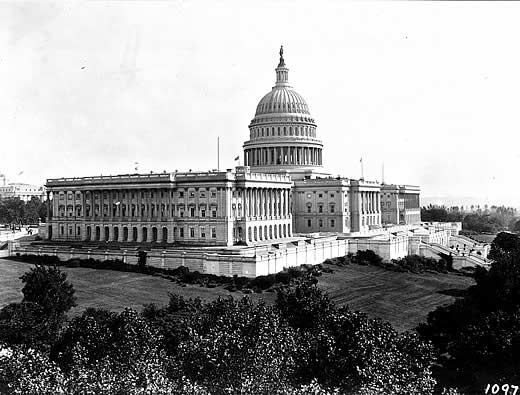
United States Congress, Washington D.C. (1920)
Edited by Mark A. Allen (2021)
The boom of the Second Industrial Revolution in America from 1870 through to 1920, markedly transformed the ways Americans related to the environment, from how they used it and worked with it to how they thought about it. During this fifty-year period, employment in American Manufacturing grew to 4.5 times its original force, from 2.5 million Americans employed to roughly 11.5 million, bringing with it an increase in labor power, and a demand for materials and energy as well. Public sentiments on nature and the environment of America also shifted in this era. Through the contributions of countless passionate Americans, including the storied writer Mark Twain, the photographer William Henry Jackson, the frontier historian Fredrick Jackson Turner, and the naturalists Anna Botsford Comstock and John Muir, conservationist thought began to take shape.
These seemingly conflicting concepts of industry and nature came together in Fox River, Wisconsin on August 20, 1882, when Henry J. Rogers's Appleton Edison Light Company switched on the first ever hydroelectric generator. With an output of around fifty watts of power, and the capability of powering nearly 250 incandescent lightbulbs, its opening cemented Fox River in both industrial and environmental history. Not only was this a landmark moment for a novel use of natural resources to generate power, but it also set the stage for future adoption by the industrial sector. Similar hydro turbine generators were created to power a variety of amenities, from streetlights in Niagara, New York, to theatrical performances in Grand Rapids, Michigan. The advent of alternating current systems during the 1880s made possible the creation of the first ever Hydropower plant, Redlands Power Plant, which opened in California in 1893.
Not until the years between 1917 and 1920 did this promising method of environmentally friendly power generation gain traction with the American government. The Federal Government's turn towards conservationism began with President Theodor Roosevelt, an avid outdoorsman. He had pushed for the creation of fifty-one wildlife refuges and five national parks with numerous other conservation acts before his presidency's end in 1909. President William Howard Taft continued these policies, but it was President Woodrow Wilson who signed the first law regulating and promoting hydroelectric power generation. On June 10, 1920 Wilson, a historian, free market Liberal, and economic moralist, signed into law the Federal Power Act which had been passed by the Sixty-Sixth Congress. This Act led to the creation of the Federal Power Commission, a governmental agency which counts more than 90 years of service today. The Act also regulated hydroelectric power and furthered the creation of hydropower plants around the United States by the Army Corps of Engineers.
CHAP. 285.- An Act To create a Federal Power Commission; to provide for the improvement of navigation; the development of waterpower; the use of the public lands in relation thereto, and to repeal section 18 of the River and Harbor Appropriation Act, approved August 8, 1917, and for other purposes.
Be it enacted by the Senate and House of Representatives of the United States of America in Congress assembled, that a Commission is hereby created and established, to be known as the Federal Power Commission (hereinafter referred to as the commission), which shall be compose of the Secretary of War, the Secretary of the Interior, and the Secretary of Agriculture. Two members of the commission shall constitute a quorum for the transaction of business, and the commission shall have an official seal, which shall be juristically noticed. The President shall designate the chairman of the commission.
Sec.2. That the commission shall appoint an executive secretary, who shall receive a salary of $5,000 a year, and prescribe his duties, and the commission may request the President of the United States to detail an officer from the United States Engineer Corps to serve the commission as engineer officer, his duties to be prescribed by the commission.
The work of the commission shall be performed by and through the Departments of War, Interior, and Agriculture and their engineering, technical, clerical, and other personnel except as may be otherwise provided by law.
All the expense of the commission, including rent in the District of Columbia, all necessary expenses for transportation and subsistence, including, in the discretion of the commission, a per diem of not exceeding $4 in lieu of subsistence incurring by its employees under its orders in making any investigation, or conducting field work, or upon official business outside of the District of Columbia and away from their designated points of duty, shall be approved and paid on the presentation of itemized voucher therefor approved by a member or officer of the commission duly authorized for that purpose; and in order to defray the expenses made necessary by the provisions of this Act there is hereby authorized to be appropriated such sum as Congress may hereafter determine, and the sum of $100,000 is hereby appropriated, out of any moneys in the Treasury upon order of the commission.
Sec.3. That the words defined in this section shall have the following meanings for the purposes of this Act, to wit:
“Public lands” means such lands and interest in lands owned by the United States as are subject to private appropriation and disposal under public-land laws. It shall not include “Reservations,” as hereinafter defined.
“Reservations” means national monuments, national parks, national forests, tribal lands embraced within Indian Reservations, military reservations, and other lands and interests in lands owned…
U.S. Statutes at Large, Vol. 41, Part 1, Chap. 285, pp. 1063-1077. “An Act To create a Federal Power Commission; to provide for the improvement of navigation; the development of water power; the use of the public lands in relation thereto, and to repeal section 18 of the River and Harbor Appropriation Act, approved August 8, 1917, and for other purposes.” H.R. 3184, Public Act No. 280. From “The Evolution of the Conservation Movement, 1850-1920.” Library of Congress. Accessed September 20, 2021. http://memory.loc.gov/cgi-bin/query/r?ammem/consrvbib:@FIELD(NUMBER(vl037)).
Foley, Bradley R., and Robert M. Calhoon. “Woodrow Wilson and Political Moderation.” The Journal of Presbyterian History 85, no. 2 (2007): 137–50.
Foner, Eric. Give Me Liberty! Volume 2, 3rd ed. New York, NY: W. W. Norton, 2011.
Kuzmiak, D. T. “The American Environmental Movement.” The Geographical Journal 157, no. 3 (1991): 265-278.
Moler, Elizabeth, David Ward, Robert Platt, Sherman Poland, and David Benkin. “Review of A Salute: 75 Years for the FPC and FERC.” Energy Law Journal 18, no. 2 (1995): 293-297.
Moran, Emilio F., Maria Claudia Lopez, Nathan Moore, Norbert Müller, and David W. Hyndman. “Sustainable Hydropower in the 21st Century.” Proceedings of the National Academy of Sciences of the United States of America 115, no. 47 (2018): 11891–11898.
Nash, Roderick Frazier. Wilderness and the American Mind, 5th ed. New Haven: Yale University Press, 2014 [1967].